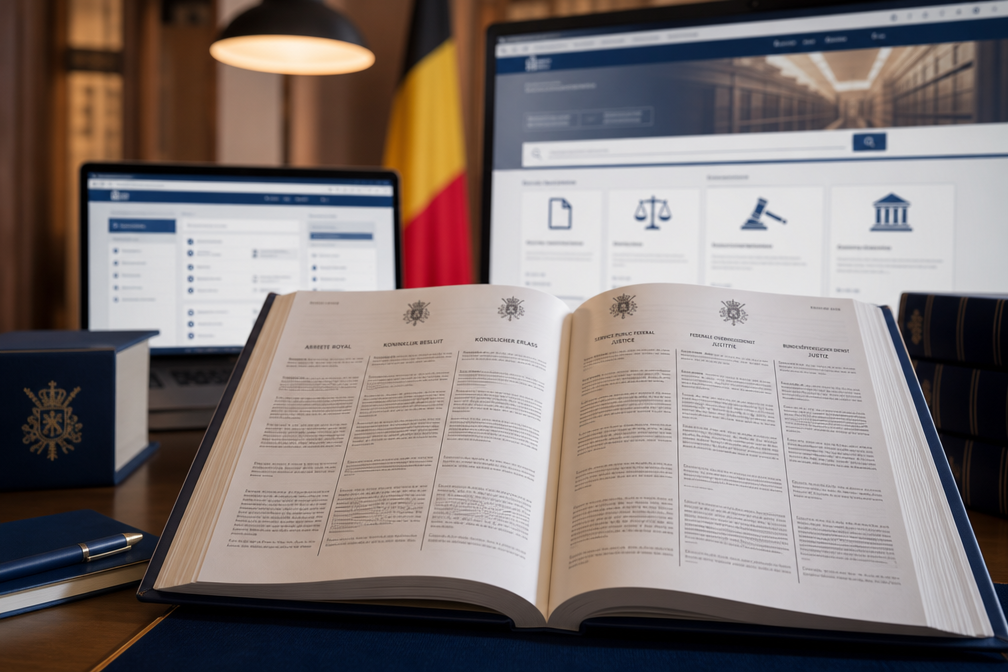
International entrepreneurs who deal with Belgian companies often encounter a puzzling requirement: mandatory publication in something called the Belgian Official Gazette. Despite its importance for business compliance, the system remains unfamiliar to those new to Belgian administrative procedures. This guide explains what it is, what it publishes and how it works.
Quick answer: the Belgian Official Gazette is Belgium’s official government publication for laws, decrees and company-related legal notices. It is the same publication known as “Belgisch Staatsblad” in Dutch, “Moniteur belge” in French and “Belgisches Staatsblatt” in German. Company formations, changes and dissolutions are published in its annexes to have legal effect against third parties. It is published by the Federal Public Service Justice and is freely accessible at ejustice.just.fgov.be.
In short
- The Belgian Official Gazette is Belgium’s single official publication for laws and company notices, appearing under different names in the three national languages.
- It is published by the Federal Public Service Justice; the printed edition was discontinued in 2003 and replaced by an electronic version.
- Company and association acts appear in the annexes, linked to the Crossroads Bank for Enterprises (CBE) since 1 July 2003.
- All publications are freely accessible online at ejustice.just.fgov.be.
- Legal acts become enforceable against third parties only after publication in the gazette’s annexes.
What is the Belgian Official Gazette?
The Belgian Official Gazette is Belgium’s official publication system and the authoritative source for government legislation and legal notices. It is a single publication that operates under different names across Belgium’s three official languages, but always refers to the same governmental publication managed by the Federal Public Service Justice.
The gazette publishes two main categories of content. First, it contains government legislation: laws, royal decrees, decrees and ordinances that shape the Belgian legal framework, together with official notices. Second, it publishes the acts of legal entities such as companies and associations, in dedicated annexes called the “Annexes to the Belgian Official Gazette.”
Since 2003, the Belgian Official Gazette has been published in electronic format, replacing its former printed edition. That transition coincided with the introduction of the Crossroads Bank for Enterprises (CBE), which centralised business registration in Belgium.
For international entrepreneurs, understanding this system matters because any significant company action in Belgium, establishing a subsidiary, changing company details or appointing new directors, must appear in the annexes before it becomes enforceable against third parties.
Belgian Official Gazette structure and content
The Belgian Official Gazette organises official publications into clear categories. Understanding this structure helps international entrepreneurs navigate publication requirements.

Government publications
The main body of the gazette contains official government communications, including:
- laws passed by the federal parliament;
- royal decrees;
- regional and community decrees;
- ministerial ordinances;
- official notices from government agencies.
These publications establish the legal framework within which Belgian businesses operate.
Annexes to the Belgian Official Gazette
The annexes contain the acts of legal entities and are the section most relevant to entrepreneurs. Since 1 July 2003, company and association acts have been published together in these annexes, including:
- company formations and incorporations;
- statutory amendments and changes;
- director appointments and resignations;
- registered office relocations;
- company dissolutions and liquidations.
Enterprise number integration
Each publication in the annexes links to the company’s enterprise number from the Crossroads Bank for Enterprises (CBE). This keeps the official registry and the published notices consistent, creating a comprehensive record of a company’s legal status. The services offered for company publications handle this linkage as part of the process.
Publication languages
Publications appear in the official language of the company’s registered location: Dutch for companies in the Flemish Region, French for the Walloon Region, German for the German-speaking Community, and one of the national languages for entities in the Brussels-Capital Region.
How the Belgian Official Gazette publication process works
The publication process follows established procedures that ensure legal compliance and proper documentation.

Submission requirements
Depending on the type of act, a submission generally includes:
- properly executed legal documents (such as notarial acts or board resolutions);
- completed publication forms with the required information;
- supporting documentation proving the authority to submit;
- payment of the applicable publication fees.
Electronic publication
Since 2003 the gazette is published electronically by the Federal Public Service Justice. In practice, an act is filed with the court registry (griffie) of the competent Enterprise Court, after which the extract is forwarded and published in the annexes. Once published, it becomes available through the online portal at ejustice.just.fgov.be, where anyone can look up Belgian Official Gazette publications.
Legal effectiveness
Acts become legally effective against third parties only after publication in the Belgian Official Gazette. Company changes, director appointments and other significant acts cannot be enforced against external parties until publication occurs, regardless of when the underlying legal documents were signed.